Games
Will AI Replace Game Artists and Writers? A Grounded 2026 Look
A clear-eyed 2026 take on AI tools and game-industry craft: what official toolchains actually do, where the legal and labor questions sit, and why ‘replacement’ is the wrong frame.
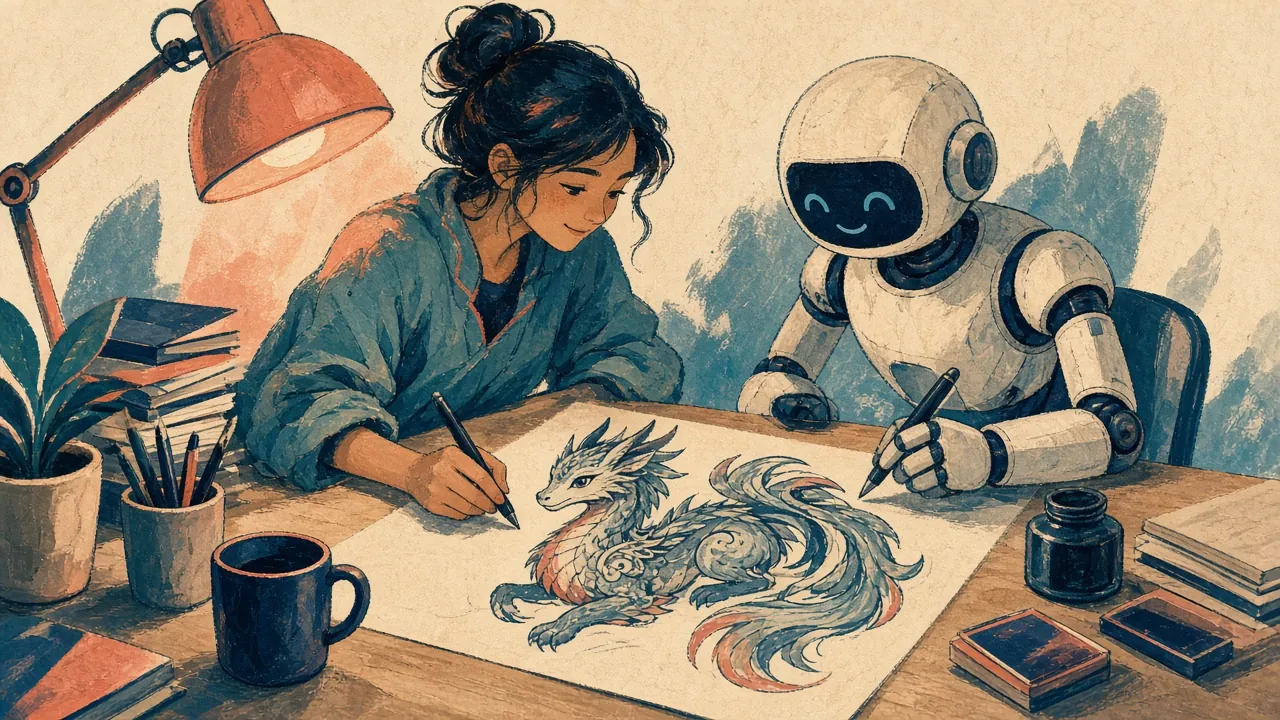
How to read this guide. This is not a prediction and not a studio investigation. Squadron Robot has not surveyed every publisher’s internal policy. We describe official tool categories, the legal uncertainty documented in our [copyright explainer](/ai-law/copyright-and-ai-cases-2026/), and a practical way to think about craft. Humor and hype both over-claim here; this piece tries not to.
The blunt question in the title is the one searchers type. It is also a bad question, because it treats “artist” and “writer” as single tasks a model can finish, and because it treats “replace” as a switch that flips in a particular year.
A more accurate 2026 picture is this: tools that generate text, images, animation support, and even conversational characters are now ordinary parts of a production conversation. Official stacks such as NVIDIA ACE for Games exist so that some of that work can run in-engine and on-device. Middleware vendors pitch infrastructure for scalable characters (Inworld’s developer blog). At the same time, the legal status of training on copyrighted books, news, and, by extension, concept art and prose is only partly settled, and the people who actually ship games still have to make things that are consistent, legal, performable, and fun for 20 to 80 hours.
Replacement, in the science-fiction sense, would require all of those constraints to go away. They have not.
What the tools actually take off a plate
Used narrowly, generative and assistive tools can:
- Multiply references and silhouettes at the start of a concept phase.
- Draft placeholder copy, quest boilerplate, or a first pass at a localized string.
- Help a programmer explain an engine error or write a test.
- Drive a bounded NPC conversation that a designer has fenced.
Used carelessly, they can also:
- Flood an art drive with almost-right images that no one owns cleanly and no one wants to paint over.
- Drift a character’s voice until a narrative director spends the savings on cleanup.
- Introduce visual or written material whose training-data provenance would not survive a license review.
- Demoralize a team if the tool is introduced as a headcount strategy rather than as a craft tool with a named owner.
That last risk is a management choice, not a model capability. Studios have always had cheaper, worse ways to make games. Some of those ways shipped. Many of them were forgotten.
The legal fog is not a side issue
If a studio uses a generator to produce a character sheet or a quest line, two questions appear immediately: did the tool’s training collide with someone’s copyright, and does the studio have a warranty that the output is safe to ship?
As of November 2026, U.S. law had started to produce real holdings and a major settlement, but not a single rule for every generative use. A Third Circuit opinion had affirmed a publisher’s win in a non-generative legal-research training case; a federal judge had found fair use for training a generative model on lawfully obtained books while rejecting a pirated library, and that case had then settled; the New York Times litigation against OpenAI and Microsoft still did not have a fair-use ruling. Those facts are walked through, with sources, in Copyright and AI in 2026.
A sober studio policy treats that fog as a reason to know the vendor’s terms, to avoid tools that cannot discuss provenance, and to keep human authors and artists in the loop for anything that will be public-facing or licensed to a platform holder. It is not a reason to pretend the law is already settled in the studio’s favor.
Labor, likeness, and credit are separate from “can the model draw”
Even if a tool is lawful to use, a performer may not have agreed to a voice clone, an artist may not have agreed to be the unnamed style in a prompt, and a writer may not have agreed to have a draft fed back into a model. Those are contract and union questions, and they are being negotiated in public in bits and pieces across entertainment industries. This article will not invent a 2026 settlement that we have not sourced. The practical advice for a working professional is straightforward: get the use, the credit, and the training-data terms in writing, and do not rely on a vendor’s blog post as your contract.
For players, credit screens and “AI was used in this production” notes — where a platform or a publisher requires them — are a start, not a complete ethics policy.
A better frame than replacement
Games are systems plus taste. Models are getting better at producing instances: a sentence, a texture, a barks line, a conversational reply. They are still poor at being the person who holds the whole system in their head: the art director who knows why the palette cannot drift in chapter three, the writer who knows which promise the prologue made, the animator who knows the climb will feel wrong if a generated cycle is one frame off.
The 2026 risk is not that those people vanish overnight. It is that some companies try to shrink those roles below the point where the work holds together, or that juniors lose the training ladder if entry-level grunt work is the only thing a tool is used to erase. Those are choices. They can be resisted in staffing plans, in contracts, and in which games players decide to support.
If you want the tool landscape without the labor frame, read how AI is used in game development. If you want the tropes players already bring to robotic characters, read robots and AI in video games.
Sources
- NVIDIA, ACE for Games
- Inworld blog, infrastructure for game and media characters
- Squadron Robot, Copyright and AI in 2026, and the court and Reuters sources cited there
Related reading
How AI Is Actually Used in Game Development in 2026
A grounded look at AI tools in game development in 2026, from official on-device character stacks such as NVIDIA ACE to everyday production uses and their limits.
Robots and AI in Video Games: A Player’s Guide to the Tropes
A spoiler-light tour of how games use robots and artificial minds as companions, bosses, puzzles, and moral tests — and how those tropes differ from real robots and AI.
AI Agents in 2026: What They Can and Cannot Reliably Do
A sober 2026 framework for AI agents that book, click, and call tools — useful jobs, failure modes, and the permissions you should not hand over unsupervised.