Humanoid Robots
Humanoid Robot Demos vs. Deployable Work in 2026
A framework for watching official humanoid videos and company claims in 2026 — what a polished demo shows, what a factory or home deployment requires, and which questions still need a source.
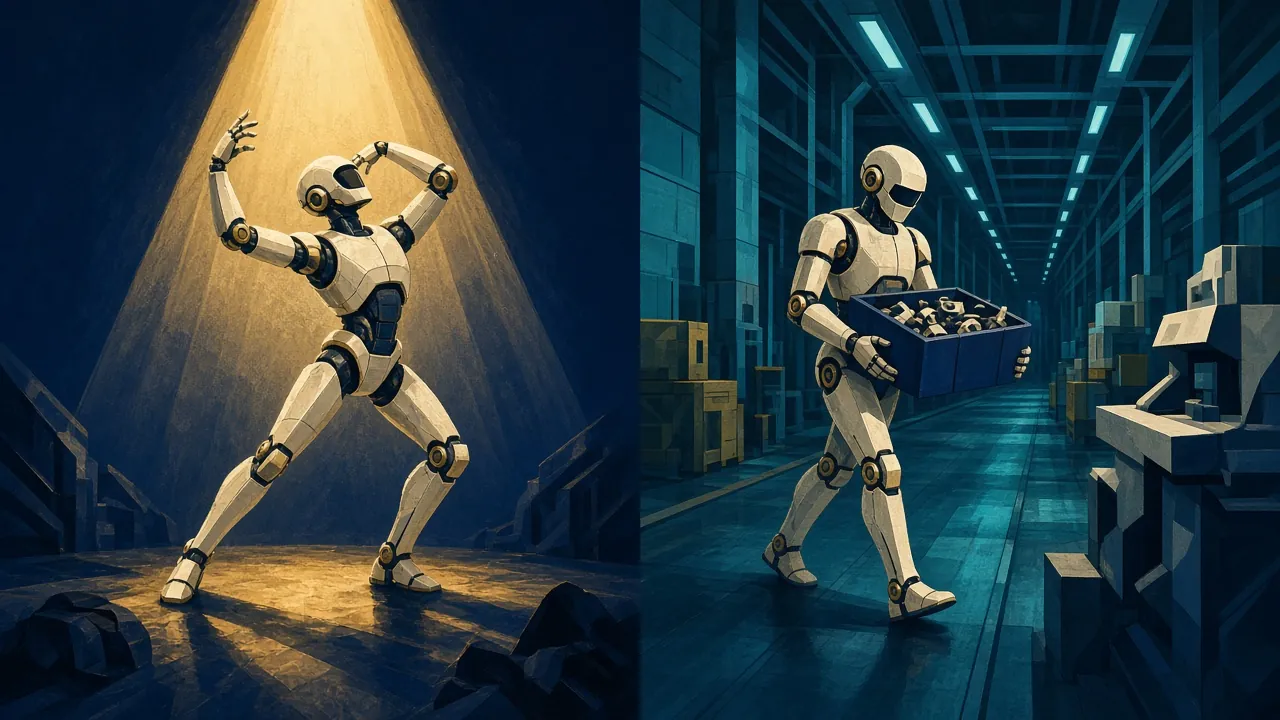
How to read this guide. Squadron Robot has not laboratory-tested Tesla Optimus, Figure 03, Boston Dynamics Atlas, 1X NEO, or any other humanoid named below. This is a framework for reading official videos and company documents, not a ranked list of winners. Company production figures and timelines are claims until a source you can check supports them.
A humanoid robot that dances, jogs, or folds a shirt on camera can be real hardware doing a real motion. It can also be a narrow slice of a much harder job: repeating that motion for a full shift, recovering when a part is slightly out of place, staying safe around people, and arriving at a price a factory or a household can actually pay.
In 2026 the gap between those two things is the useful story. Official channels are the right place to watch the machines — Boston Dynamics’ “Atlas Goes Hands On” is one example from the company’s own YouTube account — but a video is a demonstration until the company also shows where the robot is working, for whom, and under what limits.
What a demo is good for
A carefully shot demo can still be informative. It can show that a design has enough range of motion to pick up a tote, climb a step, or catch itself after a shove. It can show a new generation of hardware: Boston Dynamics moved Atlas from a hydraulic research platform to an all-electric product design, and the official videos are how most of the public first saw that change.
Watch official video for:
- Whether the motion is being done by the robot itself, or with obvious teleoperation. Some products, including 1X’s NEO, describe a scheduled “Expert Mode” in which a 1X expert can remotely supervise tasks the robot has not learned yet (1X, Order NEO). That is not a hidden trick if the company says so. It is a product choice, and it belongs in the same sentence as “autonomy.”
- Whether the environment is a clean stage or a messy aisle. Tight, repeating motions on a marked floor are easier than an unstructured kitchen.
- Whether the company also publishes the unexciting documents: payload, runtime, safety features, intended use, and who can actually buy one.
A demo is a poor place to infer shift-long reliability, cost per pick, or “this will be in homes this year.”
What “deployable work” actually requires
Deployable work, as factories and warehouses use the phrase, is narrower than a keynote. A robot that is doing a job usually has:
- A defined task (parts sequencing, tote handling, line-side delivery), not “general-purpose housework.”
- A site that has been prepared: chargers, keep-out zones, and a human process for when the robot stops.
- A buyer who is a company, often under a pilot agreement, not a consumer checkout page.
- Evidence of repetition, not a single impressive take.
Figure has been unusually direct about the manufacturing side of that problem. In March 2025 the company described BotQ, its in-house factory, and said the first-generation line would be “capable of manufacturing up to 12,000 humanoids per year,” with Figure 03 designed as the production robot rather than a prototype (Figure, “BotQ: A High-Volume Manufacturing Facility for Humanoid Robots”). That is a capacity and architecture claim, dated 2025. It is not, by itself, a 2026 delivery count, a public price, or a statement that those robots are already doing a full production shift at a named plant. When later coverage cites unit numbers, ask whether the number is on Figure’s own site.
Boston Dynamics’ official Atlas videos are likewise evidence of hardware and intended factory work, not a receipt that every 2026 unit is already on a Hyundai line. Treat allocation and plant-by-plant timelines as company or press statements and look for a primary page before repeating them.
A practical checklist for any 2026 claim
When a post, a keynote, or a cousin at dinner says a humanoid is “shipping,” walk through these questions:
- Who is the customer? A lab, a named factory partner, the maker’s own plant, or a household? Tesla has presented Optimus as a machine for its own factories first, and official Tesla videos such as “Optimus - Gen 2” show research and demonstration work. A public retail ship date and a public price are separate facts. If you cannot find them on Tesla’s own site, do not invent them.
- Is there a public price or only a waitlist? 1X publishes an Early Access ownership price of $20,000, or $499 a month, with a $200 refundable deposit, and says “US Deliveries start 2026” (1X, Order NEO). That is a real, checkable offer. It is not the same as a confirmed delivery to a specific paying household. As of this writing we have not seen 1X announce a named customer-home delivery on that order page.
- What does the robot do when it does not know the task? Teleoperation, a narrow skill library, or a stop-and-ask behavior all count as honest engineering. Hidden remote control in a “fully autonomous” clip does not.
- What are the safety limits? Payload, pinch points, speed near people, and what happens if a child or a pet walks in front of the robot are ownership questions, not marketing afterthoughts. 1X’s order page, for example, emphasizes a soft lattice body, covered joints, and low-inertia tendon drives — again, as company specifications, not as our test results.
- What has to be true on the site? Lighting, Wi-Fi or on-device compute, floor clutter, and a charger the robot can actually reach will decide more deployments than a 15-second vault.
Why the humanoid shape is a special case
A wheeled warehouse robot can be excellent at a job and still look boring on video. A humanoid looks like a person, so viewers grant it a person’s flexibility. The shape is a bet: if the robot can use tools, stairs, and aisles already built for people, it might not need a redesigned factory. That bet is why so many well-funded programs exist.
It is also why demos are unusually persuasive. A humanoid carrying a box looks like “work.” The questions that decide whether it is work — cycle time, failure rate, maintenance, and integration — almost never fit in a trailer. For a closer look at how today’s programs describe themselves, see our 2026 humanoid line map. If you are looking at a home machine, start with the questions to ask before a home humanoid.
How we will update this
If a company publishes a numbered deployment, a public price, or a safety standard on an official page, this article should be updated to cite it. Until then, the honest position is simple: 2026 is a year of real hardware, real factories being stood up, and real official video. It is not yet a year in which a casual viewer can treat every impressive clip as a product you can hire or bring home.
Related reading

If You Are Considering a Home Humanoid in 2026, Ask These Questions
A practical, sourced checklist for anyone looking at a household humanoid pre-order in 2026 — privacy, teleoperation, stairs, pets, refunds, and what ‘deliveries start this year’ does and does not mean.
Figure, Optimus, Atlas, Unitree, and 1X: A 2026 Humanoid Line Map
A research-based map of major humanoid programs in November 2026 — what the companies themselves publish about products, factories, and prices, without a fake bake-off.

AI Agents in 2026: What They Can and Cannot Reliably Do
A sober 2026 framework for AI agents that book, click, and call tools — useful jobs, failure modes, and the permissions you should not hand over unsupervised.