Humanoid Robots
Figure, Optimus, Atlas, Unitree, and 1X: A 2026 Humanoid Line Map
A research-based map of major humanoid programs in November 2026 — what the companies themselves publish about products, factories, and prices, without a fake bake-off.
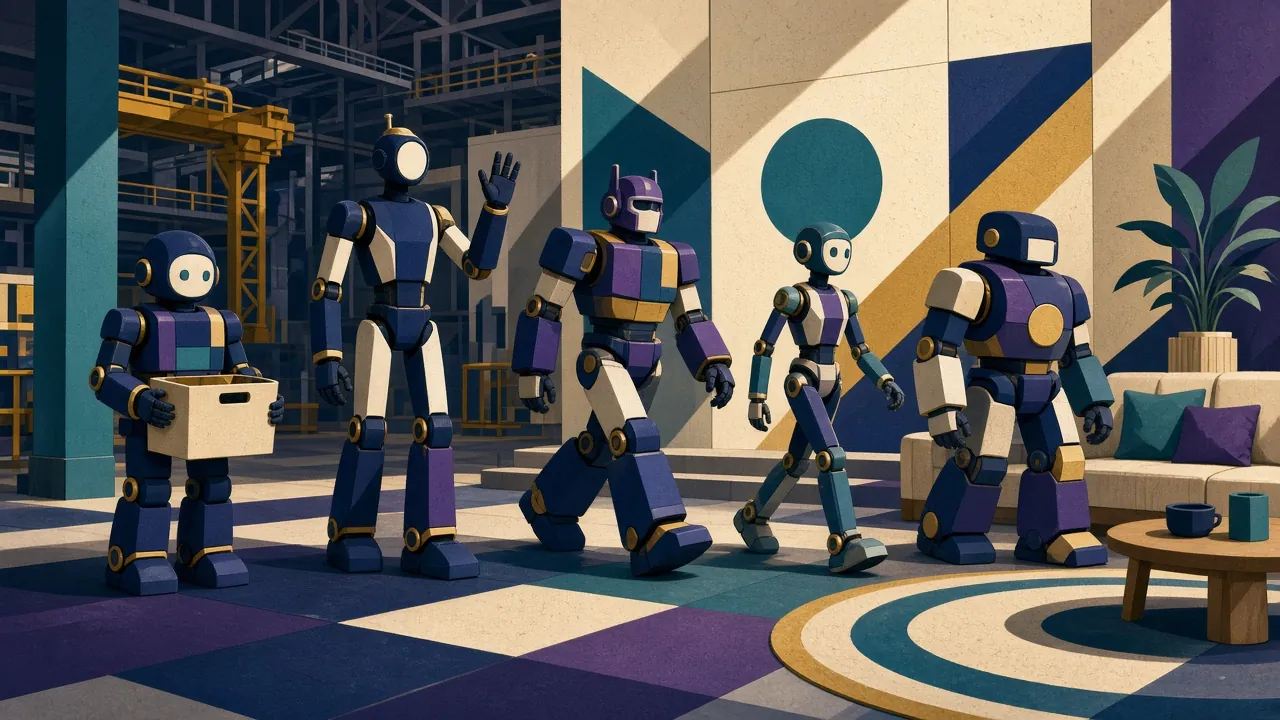
How to read this guide. This is a line map of public, official descriptions, not a laboratory comparison and not a “best humanoid of 2026” list. Squadron Robot has not tested these machines. Specifications and production plans are the companies’ claims. Where we cannot find a fact on an official page, we say so instead of filling the gap from unsourced blogs.
Five names dominate most 2026 conversations about humanoids in the United States: Figure, Tesla’s Optimus, Boston Dynamics’ Atlas, Unitree, and 1X’s NEO. They are not doing the same job. Some are selling research platforms. Some are building factory partners. One is taking consumer pre-orders for the home. Putting them on a single scoreboard hides the only comparison that matters: what is actually on offer, to whom, and with what caveats.
Figure — production design, commercial customers
Figure describes Figure 03 as its production robot, designed for high-volume manufacturing rather than as a one-off prototype. The company’s March 15, 2025 BotQ announcement said the first-generation manufacturing line would be “capable of manufacturing up to 12,000 humanoids per year,” with core assemblies brought in-house and a plan to use Figure robots in that process (Figure, BotQ). The later product post, “Introducing Figure 03”, presents 03 as a robot for commercial work and, eventually, the home, running Figure’s Helix model.
What we can say from those pages: Figure is trying to be a manufacturer, not only a lab. What those pages do not, by themselves, give a careful reader: a public retail price, an independently audited 2026 shipment total, or a promise that a consumer can order one today. If you see a precise “units delivered” number elsewhere, check whether Figure has published it. The official Introducing Figure 03 video is the right place to see the company’s own demonstration, not a third-party compilation.
Tesla Optimus — factory-first, official video, few public specs
Tesla has shown Optimus repeatedly on its official YouTube channel, including “Optimus - Gen 2” and “Optimus Navigating Around”. Those videos are primary sources for what Tesla wants the public to see: a bipedal robot intended, first, for work inside Tesla’s own operations.
What we will not do here is treat a keynote target as a ship date. Tesla has not, on the official pages we reviewed for this article, published a retail price, a catalog of official payload and runtime figures comparable to a consumer product sheet, or a confirmed date when outside customers can take delivery. If and when those appear on tesla.com, they should be cited. Until then, Optimus is a serious, well-funded internal program with official demonstration video — not a product you can configure and buy.
Boston Dynamics Atlas — electric product, official demos, enterprise path
Boston Dynamics’ official channel is still the clearest public window on Atlas. “Atlas Goes Hands On” shows the electric machine doing object work, not only parkour. The company has spent years proving dynamic balance on earlier hydraulic Atlas robots; the electric product is aimed at industrial work.
Atlas is not sold like a Unitree research platform, and it is not pre-ordered like a home appliance. Press and partner comments often mention Hyundai Motor Group (Boston Dynamics’ majority owner) and research partners. Those relationships matter, but plant-by-plant deployment dates should be read from official Boston Dynamics or Hyundai pages, not from a recycled statistic. If you cannot find the number on the company’s site, treat it as unverified.
Unitree — the public storefront for research bipeds
Unitree Robotics, based in Hangzhou, is the unusual case in this set: a company that has long sold quadrupeds and, more recently, smaller humanoids through a public commercial channel aimed at researchers, developers, and education, not only at Fortune 500 pilots. That is a different market from “general-purpose factory humanoid,” and it is why Unitree machines show up in labs and on developer desks far more often than Atlas or Optimus.
Prices move, bundles differ, and regional distributors add their own terms, so this article will not freeze a dollar figure that may be out of date next month. Check Unitree’s own site for current configurations. The useful distinction is the business model: an orderable research platform is not the same product as an enterprise humanoid under a services contract, even if both have two legs.
1X NEO — the home pre-order with published terms
1X is the company in this group that publishes consumer-facing commercial terms for a household humanoid. On its official order page, NEO is offered as Early Access ownership at $20,000 with a three-year warranty and priority delivery, or as a $499-per-month subscription, with a $200 refundable deposit due at checkout. The same page says “US Deliveries start 2026” (1X, Order NEO).
NEO’s published specs are unusually detailed for this category: 5 feet 6 inches tall, 66 pounds, listed lift and carry figures, an 842 Wh battery and a claimed four-hour runtime, a soft lattice “soft body,” pinch-proof joints, and a mix of on-board autonomy (Redwood AI) plus scheduled remote “Expert Mode.” Those are 1X’s numbers, not our measurements.
Two caveats belong next to the price. First, Expert Mode means some early work may be remotely supervised by 1X staff — a fact the company states, and one a buyer should understand as a privacy and operations issue, not only as a feature. Second, “deliveries start 2026” is a company schedule. An order page is not a tracking number. If you are considering a deposit, ask 1X how refunds, delays, and teleoperation access are documented.
How to use this map
If you need a research platform with a public catalog, start with companies that actually post one. If you are a manufacturer exploring a pilot, the relevant conversations are with Figure, Boston Dynamics, and similar industrial programs, and they will not be decided by a YouTube comment. If you are a household curious about a home humanoid, 1X is the one with published consumer terms — and the right next article is what to ask before you consider one.
Other programs exist, including industrial bipeds from companies such as Agility Robotics and Apptronik. They are omitted from the five-name comparison only for space, not because they are unimportant. The same rule applies to them: cite an official page, or wait.
Sources
- Figure, “BotQ: A High-Volume Manufacturing Facility for Humanoid Robots,” March 15, 2025
- Figure, “Introducing Figure 03”
- Figure, “Introducing Figure 03” (official YouTube)
- Tesla, “Optimus - Gen 2” (official YouTube)
- Tesla, “Optimus Navigating Around” (official YouTube)
- Boston Dynamics, “Atlas Goes Hands On” (official YouTube)
- 1X, Order NEO
- Unitree Robotics
Related reading
Humanoid Robot Demos vs. Deployable Work in 2026
A framework for watching official humanoid videos and company claims in 2026 — what a polished demo shows, what a factory or home deployment requires, and which questions still need a source.

If You Are Considering a Home Humanoid in 2026, Ask These Questions
A practical, sourced checklist for anyone looking at a household humanoid pre-order in 2026 — privacy, teleoperation, stairs, pets, refunds, and what ‘deliveries start this year’ does and does not mean.

AI Agents in 2026: What They Can and Cannot Reliably Do
A sober 2026 framework for AI agents that book, click, and call tools — useful jobs, failure modes, and the permissions you should not hand over unsupervised.