Humanoid Robots
If You Are Considering a Home Humanoid in 2026, Ask These Questions
A practical, sourced checklist for anyone looking at a household humanoid pre-order in 2026 — privacy, teleoperation, stairs, pets, refunds, and what ‘deliveries start this year’ does and does not mean.

How to read this guide. Squadron Robot has not lived with a home humanoid and has not verified any customer delivery. This is a question list for reading an official offer, using 1X NEO’s published terms as the main worked example because they are public. It is not an endorsement, and it is not a prediction that a robot will do your laundry this year.
The consumer home humanoid is no longer only a concept video. At least one company, 1X, publishes a U.S. offer with a price, a subscription alternative, a deposit, and a 2026 delivery window (1X, Order NEO). That is a genuine change from the years when “a robot in the kitchen” was purely a demo. It is not the same as a mature appliance category with competing retail models, clear repair networks, and years of owner reports.
If you are even thinking about a deposit, the useful work is to slow the decision down. The questions below are the ones we would want answered in writing.
1. What work is the robot actually being sold to do?
1X describes NEO as a household machine for chores such as fetching items, with autonomy that “arrives with basic autonomy for early owners and grows in capability overtime,” plus a scheduled Expert Mode in which “an Expert from 1X can remotely supervise its actions” for tasks it does not know (1X, Order NEO). That is unusually honest wording. It also means you should ask:
- Which tasks are included on day one, and which are “roadmap”?
- Who decides that a task has been learned well enough to run without a remote expert?
- What happens if the robot cannot finish — does it stop, message you, or call a teleoperator?
A vacuum has a defined job (clean the floor you prepared). A humanoid is being asked to share a kitchen. Undefined jobs are how disappointment gets into a $20,000 purchase.
2. Who can see into your house?
Expert Mode and app monitoring are not small print. If a company can teleoperate a robot in your home, you need a clear answer to:
- When is a remote session on, and how are you notified?
- Is video, audio, or a 3D view streamed, stored, and for how long?
- Which staff can access it, and is access logged?
- Can you disable cameras, microphones, and remote control and still get support?
1X’s order page mentions a mobile app for monitoring, a voice interface, and remote control from a phone or VR device, in addition to Expert Mode. Ask for the privacy policy that governs those features, not only the marketing bullets. A household robot with a camera is closer to a live-in device than to a dishwasher.
3. What are the physical limits in your home?
Published hardware figures are a starting point, not a survey of your hallway. 1X lists NEO at 5 feet 6 inches tall and 66 pounds, with stated lift, carry, and arm-payload numbers, a claimed four-hour runtime, self-charging, IP44 splash resistance on the body, and a soft lattice covering (1X, Order NEO). Before you take those as a fit, measure:
- Staircases, thresholds, and narrow doors. “Works in a house” is not the same as “works on these stairs.”
- Pets and small children. A soft cover and covered joints are relevant safety claims; they do not replace supervision or the company’s written safety guidance.
- Clutter, cords, and wet floors. Homes are not lab kitchens.
- Where the robot will stand and charge when it is not working. A tall machine needs a home base the way a robot vacuum needs dock space.
If the company cannot tell you how the robot behaves at a stair, around a dog, or with a glass table, that is an answer.
4. What exactly are you paying for?
1X’s published options are Early Access ownership at $20,000, with a three-year warranty, premium support, and priority delivery, or a $499 monthly subscription, with a $200 refundable deposit and the line “US Deliveries start 2026” (1X, Order NEO). Ask, in writing:
- What makes the deposit refundable, and until when?
- If delivery slips past 2026, what are your options?
- What does the subscription include — hardware, teleoperation minutes, software updates, wear parts?
- What voids the warranty (pets, stairs, third-party repair)?
- What happens at the end of the subscription — return shipping, data deletion, buyout?
A refundable deposit is better than a non-refundable one. It is not a substitute for a delivery date you can enforce.
5. How will support work when it breaks?
Humanoids have many actuators. 1X even publishes service-cycle figures for its tendon drives on the order page. The ownership question is more ordinary: who comes to the house, how long is a typical repair, and what do you do with a 66-pound machine that will not stand up? If the answer is “ship it back,” factor that into the real cost.
6. Do you actually need a humanoid for this job?
This is the question a humanoid pitch would like you to skip. Many household jobs already have special-purpose robots with years of owner experience: floor cleaners, mowers, pool cleaners. They are limited, and those limits are known. A general-purpose humanoid is a bet that one machine can eventually do many of those jobs — a bet that is still being tested in 2026, mostly in early-access form.
If your real need is “floors and the lawn,” a squadron of special-purpose machines is still the conservative path. If you are specifically interested in a home humanoid, go in as an early-access participant, not as someone buying an appliance with a settled job.
For context on how home offers sit next to factory programs, see the 2026 line map and demos versus deployable work.
Related reading
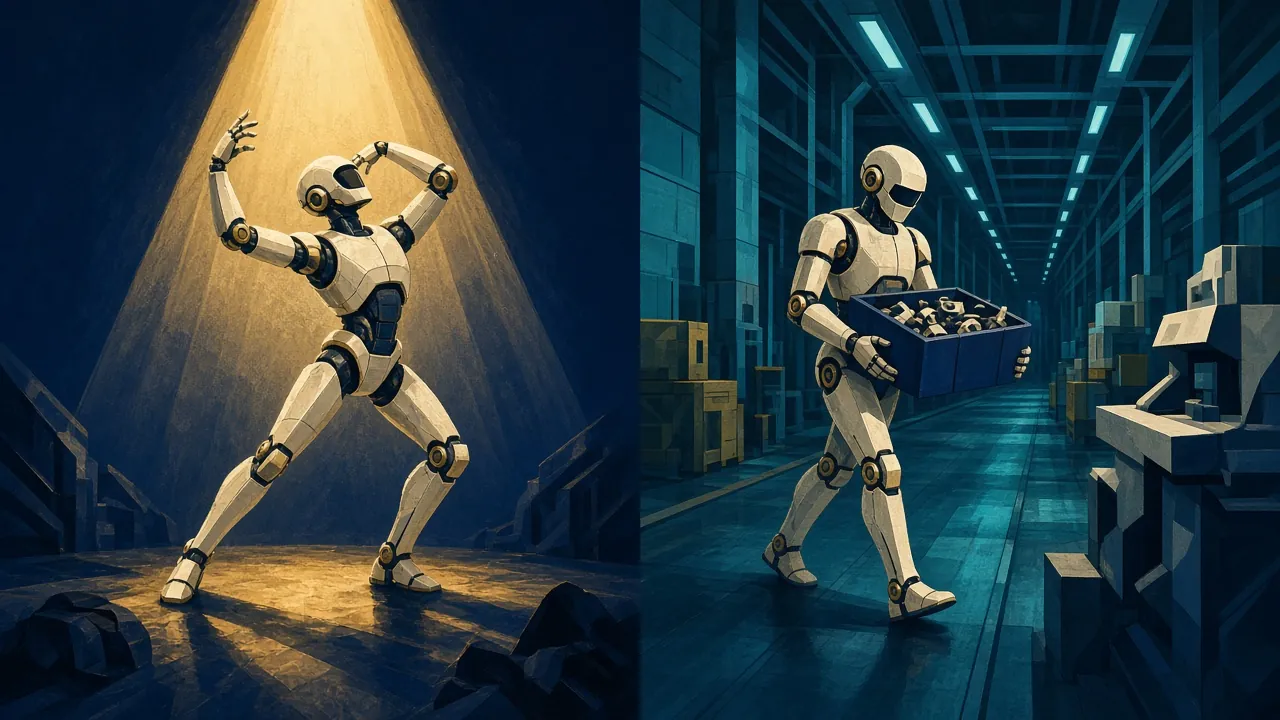
Humanoid Robot Demos vs. Deployable Work in 2026
A framework for watching official humanoid videos and company claims in 2026 — what a polished demo shows, what a factory or home deployment requires, and which questions still need a source.
Figure, Optimus, Atlas, Unitree, and 1X: A 2026 Humanoid Line Map
A research-based map of major humanoid programs in November 2026 — what the companies themselves publish about products, factories, and prices, without a fake bake-off.

AI Agents in 2026: What They Can and Cannot Reliably Do
A sober 2026 framework for AI agents that book, click, and call tools — useful jobs, failure modes, and the permissions you should not hand over unsupervised.